Wait, Is My Life Insurance Taxable? (The 6% Rule Most Agents Forget to Tell You)
Let’s be real for a second.
When you signed those insurance papers years ago, you probably just wanted to get it over with. You nodded at the agent, signed where they pointed, and filed the policy in a drawer thinking, “Great, if I die, at least secured na sila.”
But here is the kicker that stings a lot of families: That 5 million coverage might not actually be 5 million.
Depending on how you filled out that form, the government might be waiting to take a 6% cut before your family sees a single centavo. Sayang naman, ‘di ba?
If you hate the idea of paying unnecessary taxes (who doesn’t?), you need to understand the difference between Income Tax and Estate Tax. It’s confusing, but let’s break it down.
The Good News: It’s Not “Income”
First, the easy part. If you pass away and your family gets the insurance check, do they have to declare it as income on their ITR?
No.
The Bureau of Internal Revenue (BIR) doesn’t see death benefits as “income.” They see it as compensation for a loss (you). So, in that sense, tax-free ang life insurance proceeds. Your wife or husband won’t have to pay income tax on it.
The Bad News: The “Estate Tax” Trap
This is where it gets messy.
When you die, everything you own—your house, your car, your bank accounts—gets lumped together into your “Estate.” And before your heirs can touch any of it, kailangan munang bayaran ang Estate Tax (currently a flat 6% under the TRAIN Law).
So, is your insurance policy part of your “Estate”?
It depends on one tiny checkbox you ticked years ago.
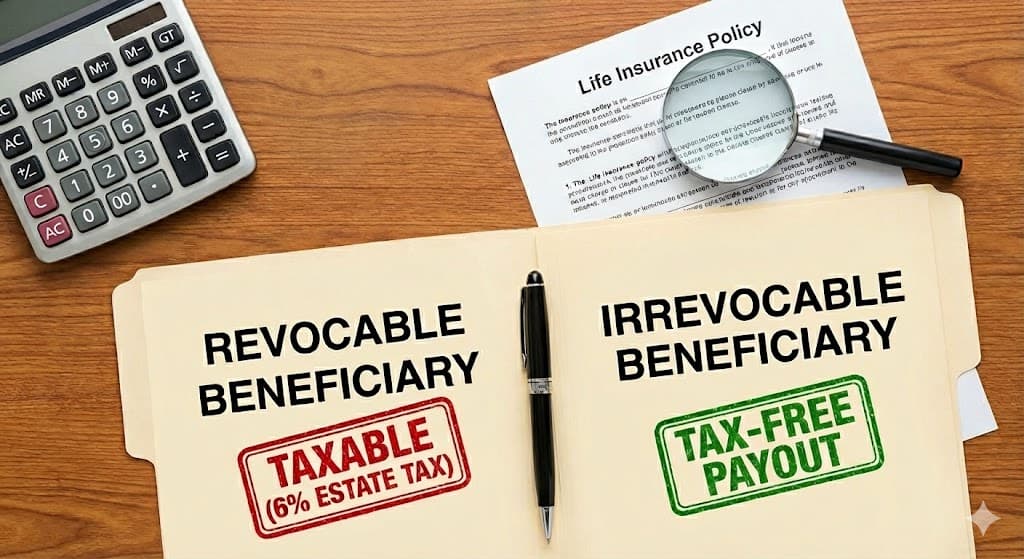
Scenario A: You Checked “Revocable” (The Default)
Most people check this because it sounds safe. “Revocable” just means you can change your mind later. If you get mad at your beneficiary, pwede mong palitan. Control is good, right?
Wrong.
Because you kept control over the policy, the law says you still owned it when you died.
- The Result: The 5 million payout is added to your Estate.
- The Cost: Your family effectively loses 6% of it to taxes. That’s ₱300,000 gone just because you wanted the option to change your mind.
Scenario B: You Checked “Irrevocable” (The Tax Hack)
“Irrevocable” sounds scary. It means you can’t change the beneficiary without their permission. You are effectively giving the policy to them right now.
But here is why you should probably do it anyway: Because you gave up control, the law says you don’t own it anymore.
- The Result: The payout completely bypasses your Estate.
- The Benefit: It goes straight to your family. Zero tax. Walang bawas.
“But What About My VUL?”
I get asked this a lot. “I have a VUL with investment value. If I withdraw money while I’m alive, is that taxable?”
Usually, no.
If you put in ₱500k over the years and you withdraw ₱400k for an emergency, the BIR just sees that as you taking back your own money (Return of Capital). Walang tax yun.
It only becomes taxable if you make a profit (e.g., you put in ₱500k and withdraw ₱1M). But let’s be honest—given how the markets have been lately, swerte na kung break-even tayo, so don’t stress too much about the tax on gains yet.
So, What Should You Do Today?
Don’t just take my word for it. Go find your policy (kahit maalikabok na yan) and look at the “Beneficiary” page.
Does it say Revocable?
If you are 100% sure you want that money to go to your beneficiary, text your agent and say: “Pa-change naman ng beneficiary ko to Irrevocable.”
It’s a 5-minute form that could save your family hundreds of thousands of pesos. That’s the best return on investment you’ll get all year.
—————————————————-
Disclaimer: I’m a writer, not a CPA. Tax laws in the Philippines always change. Double-check with a professional before making big financial moves.
Architect your first milestone.
Get the roadmap and join the inner circle.
The PHP 1M
Blueprint.
Comprehensive, data-driven, and designed for the Philippine professional. Get the architect's roadmap to the first million in liquid assets.